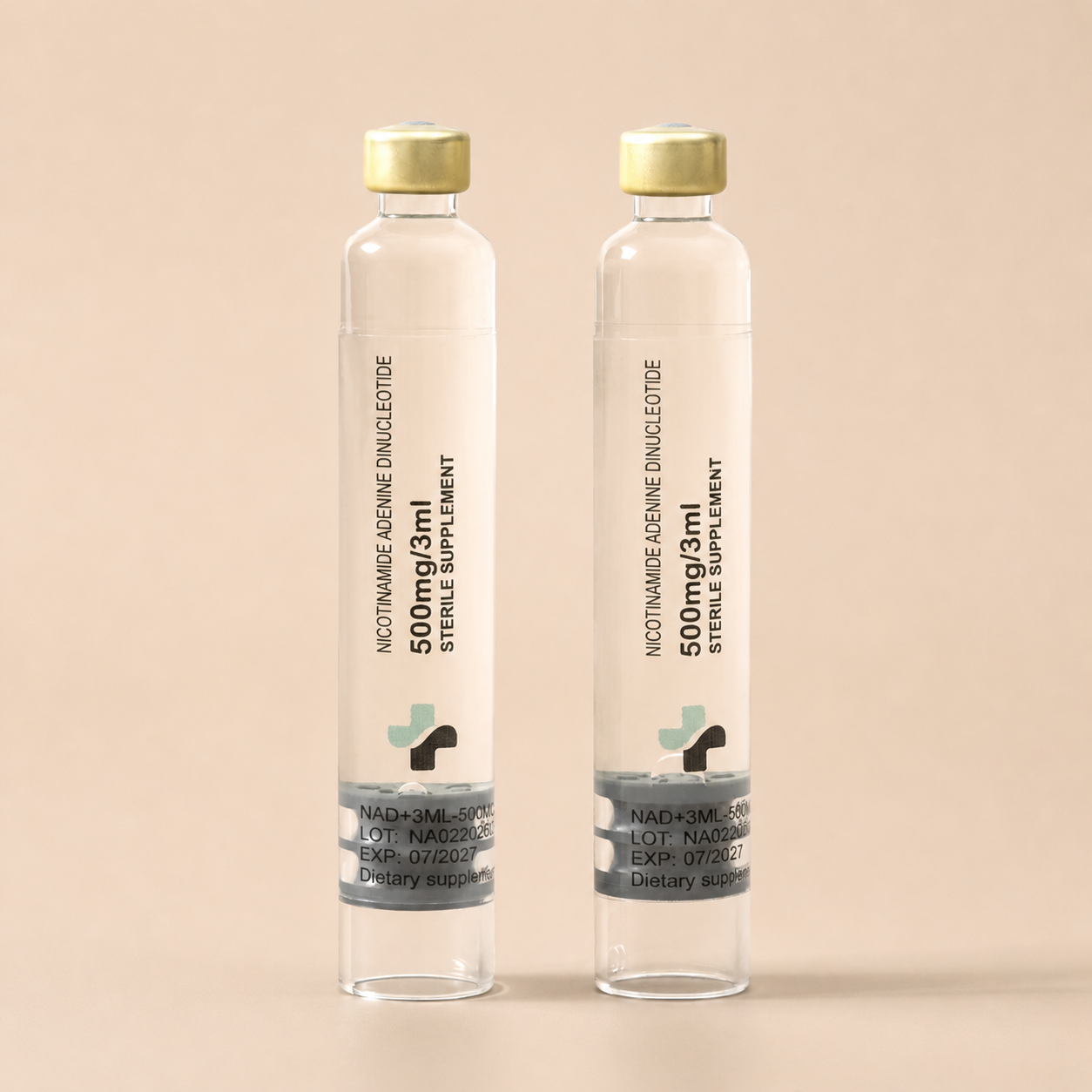
The Science of NAD+
The molecule your cells can't function without
NAD+ is one of the most studied molecules in modern biology. It powers cellular energy, activates repair pathways, and regulates the genes that govern how we age. Hundreds of peer-reviewed studies confirm its central role in human health.
Understanding NAD+
What is NAD+?
NAD+ (nicotinamide adenine dinucleotide) is a coenzyme present in every living cell. First discovered in 1906, it has become one of the most intensively studied molecules in modern biology — with over 500 published studies in the last decade alone.
NAD+ exists in two forms: NAD+ (oxidised) and NADH (reduced). Together they act as electron carriers, shuttling energy between reactions inside your cells. Without NAD+, your mitochondria cannot produce ATP — the energy currency that powers every biological process from muscle contraction to brain function.
Beyond energy production, NAD+ is a required substrate for three critical enzyme families: sirtuins (gene regulation and longevity), PARPs (DNA repair), and CD38 (immune signalling). When NAD+ levels fall, all three systems are compromised simultaneously.
The Mechanisms
Six pathways NAD+ supports in your body
NAD+ isn't a single-function molecule. It operates across multiple biological systems simultaneously — which is why its decline has such widespread effects.
Mitochondrial energy production
NAD+ drives oxidative phosphorylation — the process that converts nutrients into ATP. Over 90% of your body's energy is produced this way. When NAD+ drops, mitochondrial output falls and cellular fatigue sets in.
Cantó et al., 2015 — Cell MetabolismDNA damage repair
Your DNA sustains tens of thousands of breaks every day. PARP enzymes use NAD+ as fuel to repair this damage. Low NAD+ means slower repair, more accumulated mutations, and accelerated cellular ageing.
Fang et al., 2017 — Trends in Molecular MedicineSirtuin activation
The seven sirtuin proteins depend on NAD+ to function. They regulate gene expression, silence inflammatory pathways, and coordinate metabolic responses to stress. Sirtuins are often called the 'longevity genes' in research literature.
Imai & Guarente, 2014 — Trends in Cell BiologyCognitive function
The brain consumes roughly 20% of the body's energy despite representing only 2% of body weight. NAD+ supports neuronal energy metabolism, protects against neuroinflammation, and aids neurotransmitter synthesis.
Lautrup et al., 2019 — Cell MetabolismImmune regulation
CD38, a major NAD+-consuming enzyme, regulates immune cell function. As we age, CD38 activity increases — depleting NAD+ and contributing to chronic low-grade inflammation known as 'inflammaging'.
Camacho-Pereira et al., 2016 — Cell MetabolismCircadian rhythm
NAD+ levels naturally oscillate in a 24-hour cycle, tightly linked to your circadian clock. Disrupted NAD+ rhythms are associated with poor sleep quality, metabolic dysregulation, and impaired cellular repair during rest.
Nakahata et al., 2009 — ScienceThe Decline
NAD+ declines up to 65% between ages 30 and 70
NAD+ is a coenzyme found in every living cell that fuels energy production and cellular repair. Research shows levels naturally fall with age — contributing to fatigue, slower recovery, and accelerated ageing.
Relative NAD+ levels (%)

The Science Explained
Dr. Mark Hyman, a leading functional medicine physician, explores the science behind NAD+ supplementation — from mitochondrial energy production to sirtuin activation and the mechanisms driving age-related decline. Learn why researchers consider NAD+ one of the most promising molecules in longevity science.
Published Research
What the peer-reviewed science says
NAD+ is not a wellness trend — it is one of the most studied coenzymes in molecular biology. Below are key findings from published, peer-reviewed research.
NAD+ levels decline up to 65% between ages 30-70
Researchers measured NAD+ and related metabolites across human tissue samples of varying ages. They found a progressive, age-dependent decline in NAD+ concentration — with levels falling by approximately 65% between the third and seventh decades of life.
Massudi et al. (2012). Age-Associated Changes In Oxidative Stress and NAD+ Metabolism In Human Tissue. PLoS ONE, 7(7): e42357.NAD+ depletion disrupts nuclear-mitochondrial communication
Harvard researchers demonstrated that declining NAD+ levels cause a breakdown in communication between the cell nucleus and mitochondria, creating a 'pseudohypoxic' state that mirrors key features of ageing. Restoring NAD+ reversed this process in mice within one week.
Gomes et al. (2013). Declining NAD+ Induces a Pseudohypoxic State Disrupting Nuclear-Mitochondrial Communication during Aging. Cell, 155(7): 1624-1638.Sirtuins require NAD+ to regulate ageing
This landmark review established that all seven mammalian sirtuins depend entirely on NAD+ as a co-substrate. Sirtuin activity directly correlates with NAD+ availability — when levels drop, gene silencing and metabolic regulation are impaired.
Imai & Guarente (2014). NAD+ and sirtuins in aging and disease. Trends in Cell Biology, 24(8): 464-471.NAD+ supplementation protects against neurodegeneration
Research demonstrates that NAD+ supplementation supports neuronal health, reduces neuroinflammation, and may protect against age-related cognitive decline. The brain is particularly vulnerable to NAD+ depletion due to its outsized energy demands.
Lautrup et al. (2019). NAD+ in Brain Aging and Neurodegenerative Disorders. Cell Metabolism, 30(4): 630-655.CD38 drives age-related NAD+ decline
Researchers identified CD38 — an immune enzyme — as a primary driver of NAD+ depletion during ageing. CD38 expression increases with age and chronic inflammation, consuming NAD+ faster than the body can replenish it.
Camacho-Pereira et al. (2016). CD38 Dictates Age-Related NAD Decline and Mitochondrial Dysfunction through an SIRT3-Dependent Mechanism. Cell Metabolism, 23(6): 1127-1139.Therapeutic potential of NAD+-boosting molecules
A comprehensive review of in vivo evidence found that supplementing with NAD+ precursors improved metabolic function, protected against neurodegeneration, enhanced cardiovascular health, and extended healthspan across multiple animal models.
Rajman et al. (2018). Therapeutic Potential of NAD-Boosting Molecules: The In Vivo Evidence. Cell Metabolism, 27(3): 529-547.These statements have not been evaluated by the Food Standards Agency. This product is not intended to diagnose, treat, cure, or prevent any disease. Research cited is from published peer-reviewed studies on NAD+ and is not specific to Holte products. Always consult a healthcare professional.
As we age, levels of NAD+ naturally decline, leading to a decrease in cellular health and efficiency. Supplementing with NAD+ can help restore metabolic balance, enhance energy production, and possibly reduce some effects of aging.
— Dr David SinclairProfessor of Genetics, Harvard Medical School
Boosting NAD+ levels could be one of the most promising strategies for improving healthspan and fighting age-related diseases.
— Dr Eric VerdinPresident & CEO, Buck Institute for Research on Aging