There are three common ways to take NAD+: swallow a supplement, sit for an IV drip, or use a subcutaneous Pen at home. How much reaches your body, and what each one costs you in time and money, differs a lot. Here is how they compare.

- Bioavailability is how much of a dose your body can actually use. The route matters.
- Oral NAD+ precursors, such as NR and NMN, can raise blood NAD+, but they have to get past digestion and the liver first, and results vary between people.
- IV drips put NAD+ straight into the blood, but cost far more per milligram, take hours in a chair and deliver a large dose all at once.
- A subcutaneous micro-dose skips digestion for close to 100% bioavailability, in about a minute at home.
What is NAD+ bioavailability?
NAD+ bioavailability describes how much of a dose reaches your bloodstream in a form your body can use. Anything you swallow has to survive digestion and then pass through the liver, which breaks down part of it before it reaches the rest of the body. This is called first-pass metabolism. Routes that go into a vein or under the skin skip both steps.
Three delivery routes, three absorption profiles
1. Oral NAD+ precursors: pills and capsules
How it works: you swallow a precursor, usually nicotinamide riboside (NR) or nicotinamide mononucleotide (NMN). It is absorbed through the gut, processed by the liver and then converted into NAD+.
- What the research shows: oral NR can raise blood NAD+. In one early study, a single 1,000mg dose raised blood NAD+ up to 2.7-fold in one volunteer, and a small study in healthy adults found rises that varied widely between people.
- Pros: simple, familiar and easy to travel with.
- Cons: it has to get past digestion and the liver, results vary from person to person, and it needs a daily routine.
2. IV NAD+ drips
How it works: NAD+ is infused directly into a vein at a clinic, usually over several hours.
- What the research shows: in a pilot study, 750mg of NAD+ was infused over six hours, and plasma NAD+ only rose significantly by the six-hour mark.
- Pros: the whole dose goes straight into the blood.
- Cons: IV drips cost far more per milligram, take hours in a chair and deliver a large dose all at once, which many people find uncomfortable.
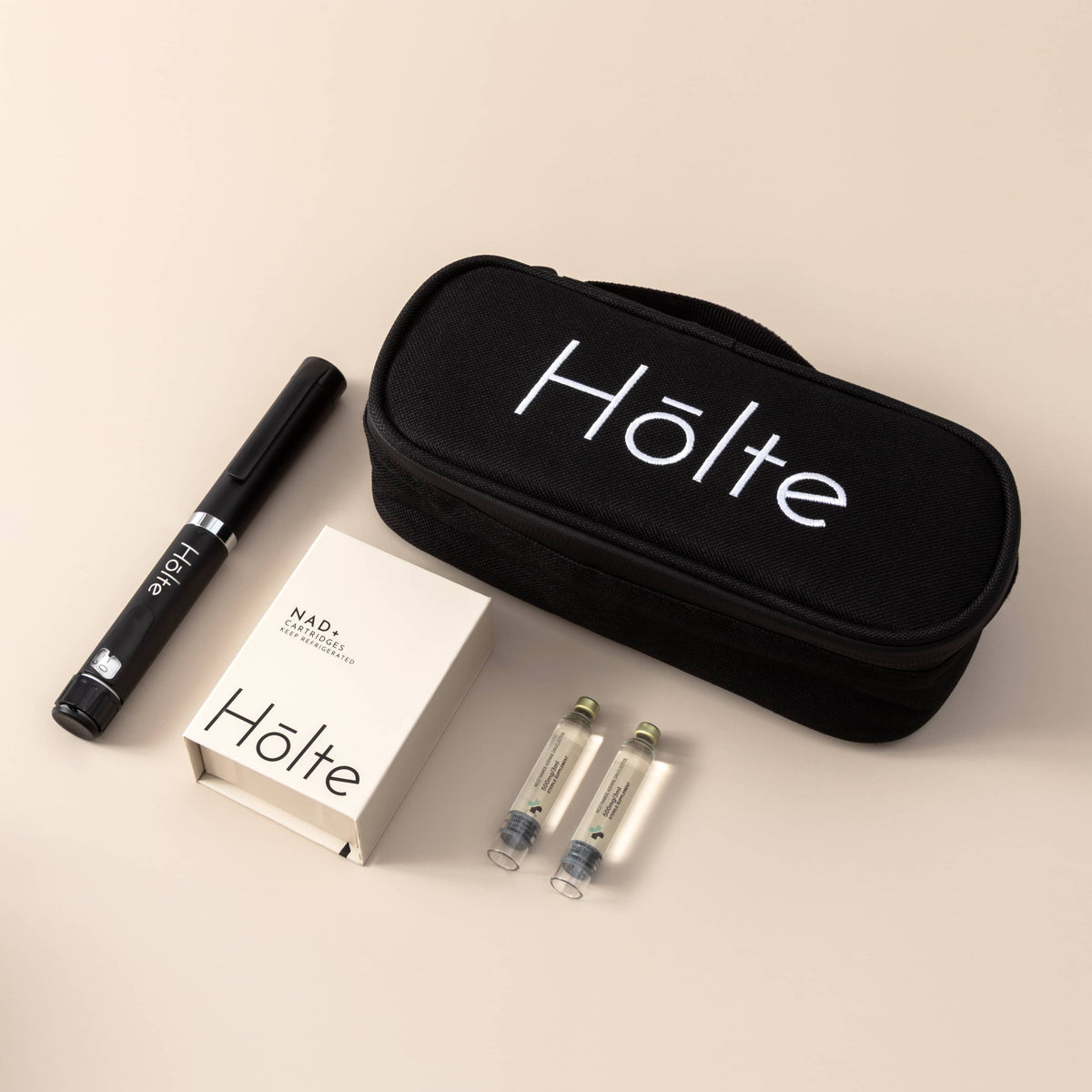
3. Subcutaneous NAD+ with the Holte NAD+ Pen®
How it works: the Pen delivers a small micro-dose of NAD+ into the layer just beneath the skin, where it is absorbed into the bloodstream.
- What the research shows: subcutaneous delivery skips digestion and first-pass metabolism, and is widely used for medicines that would otherwise be broken down in the gut.
- Pros: close to 100% bioavailability, about a minute at home, no clinic visits, and easy to fit into a routine.
- Cons: it takes a few goes to get used to, and you may notice mild, temporary sensations where you use it.
From capsules to the Pen: Aine’s switch
Aine used to take NAD+ capsules every morning. Here she explains why she moved to the Holte NAD+ Pen® and how it fits into her mornings. Her experience is her own, and everyone responds differently.
NAD+ Pen vs pills vs IV: side by side
| Pills (NR, NMN) | IV drip | Holte NAD+ Pen® | |
|---|---|---|---|
| How it works | Swallowed, absorbed through the gut, processed by the liver | Infused into a vein at a clinic | Micro-dose under the skin at home |
| Absorption | Reduced by digestion and first-pass metabolism; varies between people | Whole dose into the blood | Skips digestion; close to 100% bioavailability |
| Time | Seconds a day | Hours in a chair | About a minute |
| Cost | Lower per pack | Far more per milligram | Fixed monthly cost, no clinic fees |
| Best for | A simple, low-commitment start | Occasional supervised sessions | A consistent routine at home |
How to choose the best NAD+ delivery method
- Start with absorption. If pills haven’t made a difference, consider a route that skips digestion.
- Count time and cost, not just the price per pack. A clinic drip means travel, hours in a chair and a much higher price per milligram.
- Pick something you can keep doing. Consistency is key, so choose a routine that fits your week.
- Check what is in it. Whoever you buy from, ask for the purity and a Certificate of Analysis.
That is how we built the Holte NAD+ Pen®. The NAD+ is pharmaceutical-grade and made by us, in-house, to GMP. Every batch is third-party tested to 99.5%+ purity, and you can read the Certificate of Analysis before you buy. Tested. Retested. Verified.
Frequently asked questions
Is oral NAD+ the same as IV or a subcutaneous NAD+ Pen?
No. Oral products usually contain precursors such as NR or NMN, which your body converts into NAD+ after digestion, so the effect is indirect and varies. IV and subcutaneous routes deliver NAD+ itself and skip first-pass metabolism.
Which route has the best bioavailability?
An IV drip puts the whole dose into the blood, but over hours and at a much higher cost per milligram. A subcutaneous micro-dose gives close to 100% bioavailability in about a minute at home, which makes it the practical choice for an ongoing routine.
Will the Holte NAD+ Pen® improve my energy, focus or recovery?
Many customers use it as part of their routine for energy and recovery, but everyone responds differently. Use it as directed, and speak to your GP or pharmacist first if you have a health condition or take any medication.
Does the Pen hurt?
The Pen uses a fine micro-needle and takes about a minute. Most people feel little more than a brief scratch, and customers often tell us it’s really easy once they have done it a few times.
Is NAD+ a peptide?
No. NAD+ is a coenzyme built from two nucleotides, not a chain of amino acids, even though it comes in a similar pen to some peptide medicines. Read our guide to NAD+ vs peptides.
Sources
- Trammell SAJ, Schmidt MS, Weidemann BJ et al. (2016). Nicotinamide riboside is uniquely and orally bioavailable in mice and humans. Nature Communications 7: 12948.
- Airhart SE, Shireman LM, Risler LJ et al. (2017). An open-label, non-randomized study of the pharmacokinetics of the nutritional supplement nicotinamide riboside (NR) and its effects on blood NAD+ levels in healthy volunteers. PLoS ONE 12(12): e0186459.
- Grant R, Berg J, Mestayer R et al. (2019). A pilot study investigating changes in the human plasma and urine NAD+ metabolome during a 6 hour intravenous infusion of NAD+. Frontiers in Aging Neuroscience 11: 257.
- Bittner B, Richter W, Schmidt J (2018). Subcutaneous administration of biotherapeutics: an overview of current challenges and opportunities. BioDrugs 32: 425 to 440.
Not intended to diagnose, treat, cure or prevent any disease. Adults 18+. Read eligibility criteria before use.
Share:
Why bioavailability matters in NAD+ supplements
How to maximise your NAD+ Pen absorption