No, NAD+ is not a peptide. It is a coenzyme that every cell in your body uses to make energy. Here is how it differs from peptides such as BPC-157 and semaglutide, and why that matters if you are buying either in the UK.

The short answer
Search “NAD peptide” and you will land on clinics, forums and shops treating NAD+ as if it belongs in the same family as BPC-157 or semaglutide. It sits on the same clinic menus, comes in the same style of pen as the new weight-loss medicines, and is sometimes even sold with “peptide” in the product name.
NAD+ is not a peptide. It is a coenzyme built from two nucleotides, one carrying adenine and the other nicotinamide, a form of vitamin B3. A peptide is a short chain of amino acids. NAD+ contains no amino acids at all.
That difference matters for more than chemistry. It changes what each molecule does in the body, how much human evidence sits behind it, and how the UK regulator is treating the products built around them. Here is a plain guide to both.
What a peptide is
A peptide is two or more amino acids joined end to end by peptide bonds. Scientists draw a loose line at about 50 amino acids: shorter chains are usually called peptides, longer ones polypeptides or proteins.
Your body makes thousands of them, and many work as messengers, carrying a signal from one tissue to another. A few you may have heard of:
- Oxytocin, nine amino acids long, a hormone involved in childbirth and bonding.
- Semaglutide, a lab-made version of the gut hormone GLP-1 and the active ingredient in several licensed weight-loss and diabetes medicines.
- Collagen peptides, fragments of collagen sold as food supplements.
- BPC-157, a 15 amino acid fragment based on a protein found in gastric juice, widely sold online for recovery but not licensed for human use in the UK.
Because they are made of amino acids, most peptides are broken down in the gut much like the protein in your dinner. That is one reason so many are given by injection rather than swallowed.
What NAD+ is
NAD+ stands for nicotinamide adenine dinucleotide. It is found in every living cell and is one of the most important coenzymes in the body: a helper molecule that enzymes need before they can do their work.
The name describes the structure. Two nucleotides are joined by a bridge of two phosphate groups. One carries adenine, the same base found in DNA and in ATP, the cell’s energy currency. The other carries nicotinamide, a form of vitamin B3. The plus sign is not an add-on: it marks a positive charge on a nitrogen atom in the nicotinamide ring.
A peptide
2 to about 50 amino acids in a chain
NAD+
Two nucleotides, no amino acids
NAD+ has two main jobs:
- Moving energy. It shuttles electrons between reactions, flipping between NAD+ and NADH, which is how your mitochondria turn food into usable energy.
- Fuelling repair and signalling. It is the substrate for the sirtuin and PARP enzyme families, including the PARP enzymes that repair damaged DNA.
Your body builds NAD+ from forms of vitamin B3, including nicotinamide riboside (NR) and nicotinamide mononucleotide (NMN), and recycles it constantly. Levels are not fixed. A 2012 study of skin samples from 49 people found NAD+ fell with age in both men and women, a finding behind much of the current interest in NAD+ and healthy ageing (Massudi et al., PLoS ONE).
NAD+ and peptides side by side
The simplest test: if a molecule is not made of amino acids, it is not a peptide.
| NAD+ | Peptides | |
|---|---|---|
| What it is | One specific coenzyme | A whole class of molecules |
| Built from | Two nucleotides joined by phosphate groups | 2 to about 50 amino acids |
| Contains amino acids | No | Yes, by definition |
| Main role | Energy metabolism; fuel for repair and signalling enzymes | Mostly signalling: hormones and messengers |
| Made by your body | Yes, in every cell, from vitamin B3 precursors | Yes, thousands of different ones |
| Common forms sold | Subcutaneous Pen, IV drip, oral precursors such as NMN | Licensed prescription medicines, collagen supplements, unlicensed “research” injectables |
| Human evidence | Age-related decline well documented; research on topping it up is growing | Strong for licensed medicines; mostly animal studies for many wellness peptides |
Why NAD+ gets called a peptide, and what “NAD peptide therapy” means
The confusion is understandable, because the two arrive in the same packaging and the same conversations.
- Same delivery. Subcutaneous pens became familiar through GLP-1 weight-loss medicines, which are peptides. NAD+ now comes in a similar format, so people assume a similar molecule.
- Same menus. Longevity and wellness clinics often list NAD+ drips beside peptide injections, as though they were options from one family.
- Same vocabulary. Both are marketed with words like cellular, recovery and longevity.
- Same company in the lab. NAD+ works by binding to enzymes, and enzymes are proteins. So NAD+ turns up in the same research papers as amino acid chains, without being one.
You will also see the phrase “NAD peptide therapy”. It is clinic shorthand, not a scientific term. It usually means NAD+ drips or injections offered in the same setting as peptide treatments, sometimes as part of a package. Giving NAD+ by injection does not turn it into a peptide.
None of this makes NAD+ a peptide. It is a different molecule, with a different structure and a different job.
Are peptides safe and legal in the UK?
The short answer: it depends on the peptide. Licensed peptide medicines, such as insulin and the GLP-1 treatments, are legal and prescribed every day. Many of the wellness peptides you see online, BPC-157 included, are not licensed for human use in the UK, and the regulator is now paying close attention to how they are sold.
In April 2026 the MHRA, the UK medicines regulator, said it was investigating whether clinics were breaking the law by making health claims for unregulated, experimental peptide therapies. Its position is simple: if a clinic makes medicinal claims for a peptide injection, that product is treated as a medicine under the Human Medicines Regulations 2012.
The investigation followed a Guardian report on clinic websites describing peptides such as BPC-157 with claims about injury recovery and immune function. At least one clinic removed those claims after being contacted.
The evidence gap is real. US patient safety bodies ECRI and ISMP found that of 36 published studies on BPC-157, 35 were in animals, with no published human safety trials. Many such products are sold online as “research use only”, with no quality testing.
None of this means every peptide is suspect. Insulin and the GLP-1 medicines went through full clinical trials and are prescribed every day. It does mean the same questions are worth asking of any injectable wellness product, NAD+ included:
- What exactly is in it, and in what amount?
- Who makes it?
- Is every batch independently tested, and can you see the certificate?
- Is the seller claiming more than the evidence supports?
What this means if you are choosing
NAD+ and peptides are not rival versions of the same thing. They do different jobs, so the useful question is what you are trying to support. If your interest is cellular energy and healthy ageing, NAD+ is the molecule that research has focused on, because it sits at the centre of how cells make energy and repair themselves.
How you take it matters too. Oral NAD+ has to get past digestion first. A clinic IV drip typically delivers around 250mg in one sitting and costs considerably more per milligram. It runs over several hours, and many people find a large dose taken all at once uncomfortable. A subcutaneous micro-dose avoids the gut and gives close to 100% bioavailability, in about a minute at home.
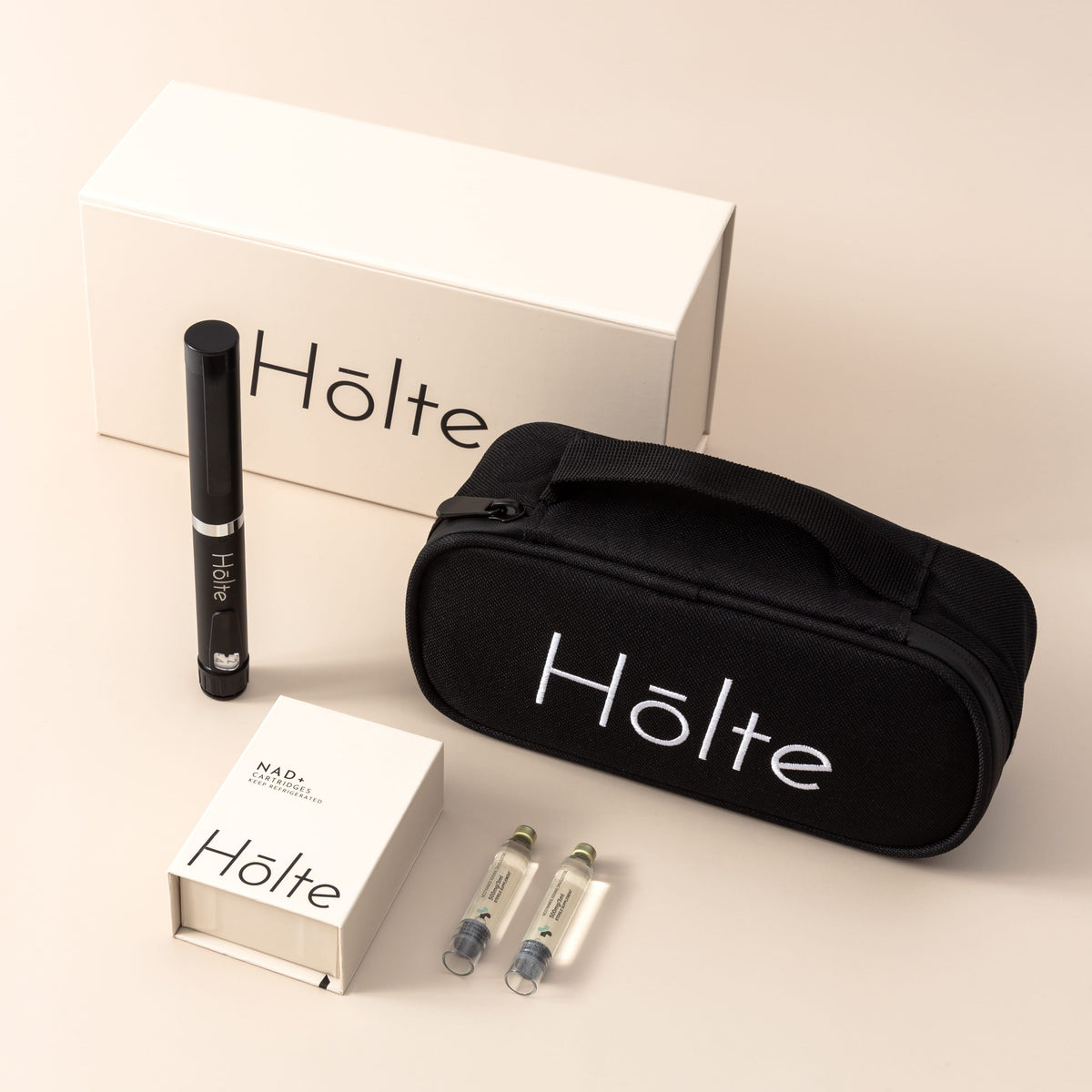
That is how we built the Holte NAD+ Pen®. The NAD+ is pharmaceutical-grade and made by us, in-house, to GMP. Every batch is third-party tested to 99.5%+ purity, and you can read the Certificate of Analysis before you buy. Tested. Retested. Verified.
One twist worth knowing: the other molecule we make, glutathione, actually is a peptide. It is a tripeptide of three amino acids (glutamate, cysteine and glycine) that your own cells produce, and it is often called the body’s master antioxidant. It is a good reminder that “peptide” describes a structure, not a promise. What matters is what is in the product, and whether you can check it.
Frequently asked questions
Is NAD+ a peptide?
No. NAD+ is a coenzyme made of two nucleotides joined by phosphate groups. Peptides are chains of amino acids, and NAD+ contains none.
What does “NAD peptide therapy” mean?
It is an informal clinic term, usually for NAD+ drips or injections offered alongside peptide treatments. It does not mean NAD+ is a peptide.
Is NAD+ a protein?
No. Proteins are long chains of amino acids. NAD+ is a much smaller molecule that works alongside proteins, helping enzymes carry out their reactions.
Is glutathione a peptide?
Yes. Glutathione is a tripeptide made from glutamate, cysteine and glycine. Your body makes it naturally, and it is often called the master antioxidant.
What is the difference between NAD+ and NMN?
NMN (nicotinamide mononucleotide) is a precursor: your body converts it into NAD+. NAD+ is the active coenzyme itself. Neither is a peptide.
Why do NAD+ and peptides both come in pens?
Many peptides are broken down by digestion, and oral NAD+ also has to get past the gut. A subcutaneous micro-dose avoids digestion, so the pen format suits both, even though the molecules are unrelated.
Are peptides legal in the UK?
Licensed peptide medicines, such as insulin and GLP-1 treatments, are prescribed through the NHS and private clinics. Many wellness peptides, including BPC-157, are not licensed for human use, and the MHRA has said that making medicinal claims for them brings them under medicines law.
Can you take NAD+ and peptides together?
They are different molecules that work in different ways, so there is no blanket answer; it depends on the specific products involved. If you take any medication or have a health condition, speak to your GP or pharmacist before starting NAD+ or any injectable product. Our team can answer product questions at support@holtehealth.com.
Sources
- National Cancer Institute. Definition of peptide. NCI Dictionary of Cancer Terms.
- StatPearls. Biochemistry, Peptide. NCBI Bookshelf, National Library of Medicine.
- RxList. Medical definition of peptide.
- Massudi H, Grant R, Braidy N et al. (2012). Age-associated changes in oxidative stress and NAD+ metabolism in human tissue. PLoS ONE 7(7): e42357.
- Viswamitra MA (1975). Molecular structure of nicotinamide adenine dinucleotide. Nature 258: 540 to 542.
- Ji X, Zheng M, Yu T et al. (2023). NAD+-consuming enzymes in stem cell homeostasis. Stem Cells International.
- Patient Safety Learning, reporting the Guardian (4 April 2026). Medicines watchdog to investigate UK peptide clinics over health claims.
- Aesthetics Journal (2026). MHRA investigates clinics following peptide claims.
- ECRI and ISMP (2026). Patients using wellness peptides have no reliable information about whether they are safe or effective.
Not intended to diagnose, treat, cure or prevent any disease. Adults 18+. Read eligibility criteria before use.
Share:
Troubleshooting the NAD+ Pen: quick fixes
Peptide dose calculator: convert mg and mcg to syringe units