NAD+ is one of the most important molecules in your body, and one of the least understood. This is the science in plain English: what NAD+ does, which enzymes make and use it, and why levels fall as we age.

NAD+ 101
NAD+ (nicotinamide adenine dinucleotide) is a coenzyme found in every cell. It is central to turning the food you eat into ATP, the energy your cells run on. Without NAD+, your cells could not function.
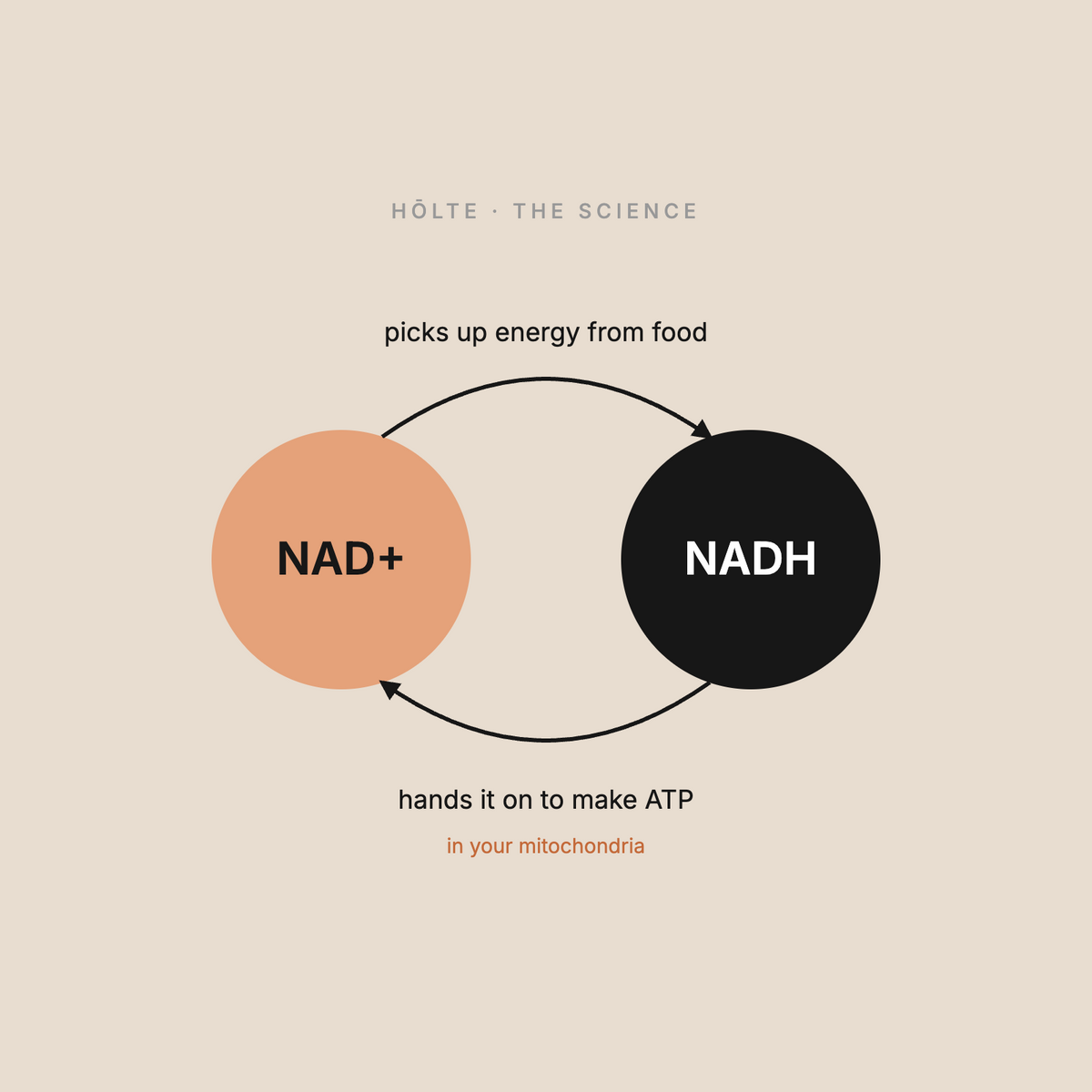
NAD+ is the empty battery; NADH is the charged one. NAD+ picks up electrons as your cells break down food, becoming NADH. NADH delivers them to your mitochondria to make ATP, and is turned back into NAD+, ready to go again.
How NAD+ works in the body
Energy
NAD+ carries electrons through the mitochondrial electron transport chain to make ATP, especially when demand is high, such as during exercise.
Repair
NAD+ activates sirtuins and PARP enzymes, which are involved in DNA repair, stress responses and the body clock.
Signalling
NAD+ supports brain cell repair and neurotransmitter function, and plays a role in how cells communicate.
The NAD+ balance: making it and using it
Your body is constantly making NAD+ and using it up. Most is recycled through a salvage pathway that relies on an enzyme called NAMPT, and some is built from forms of vitamin B3. At the same time, enzymes such as PARPs, sirtuins and CD38 consume it as they work.
Why NAD+ levels decline with age
Research in human tissue found NAD+ fell by up to 65% between the ages of 30 and 70. Scientists think the balance shifts in two ways. Enzymes that consume NAD+, especially CD38, become more active with age. At the same time, the recycling pathway that rebuilds NAD+ slows. Lifestyle factors such as heavy drinking, a poor diet and lack of sleep can tip the balance further.
Lower NAD+ is linked to signs of ageing such as low energy and slower recovery. In animal studies, restoring NAD+ has improved several markers of ageing, and human research is now growing.
Ways to support NAD+
- Exercise and eating patterns. Regular activity, and eating patterns such as calorie restriction, are linked to healthier NAD+ levels.
- Vitamin B3 precursors. Niacin, nicotinamide riboside (NR) and nicotinamide mononucleotide (NMN) give your body raw materials to make NAD+, though they have to get past digestion and be converted first.
- NAD+ itself. IV drips and subcutaneous pens deliver NAD+ directly. IV drips cost far more per milligram and take hours; a subcutaneous micro-dose gives close to 100% bioavailability in about a minute at home.
For a side-by-side, read NAD+ Pen vs pills vs IV: absorption compared.
Frequently asked questions
What is the difference between NAD+ and NADH?
They are two forms of the same molecule. NAD+ collects electrons; NADH carries them to the mitochondria to make energy.
What is CD38?
An enzyme that breaks down NAD+. Research suggests it becomes more active with age, which is one reason NAD+ levels fall.
Is NAD+ a vitamin?
No. Your body makes NAD+ from forms of vitamin B3, but NAD+ itself is a coenzyme.
Sources
- Covarrubias AJ, Perrone R, Grozio A, Verdin E (2021). NAD+ metabolism and its roles in cellular processes during ageing. Nature Reviews Molecular Cell Biology 22: 119 to 141.
- Massudi H, Grant R, Braidy N et al. (2012). Age-associated changes in oxidative stress and NAD+ metabolism in human tissue. PLoS ONE 7(7): e42357.
- Verdin E (2015). NAD+ in aging, metabolism, and neurodegeneration. Science 350: 1208 to 1213.
Not intended to diagnose, treat, cure or prevent any disease. Adults 18+. Read eligibility criteria before use.
Share:
The benefits of NAD+ for general health and wellness
NAD+ for sleep and stress: can NAD+ improve rest and resilience?